Modernize healthcare management through Plurance’s custom EHR systems, combining strong security, smooth integrations, efficient workflows, and actionable insights
Healthcare is digitizing at a faster pace than ever before. Institutions such as hospitals, clinics, and diagnostic centers are digitizing their records, moving from paper records to smart software solutions, from paper records to effectively deal with patient data. In this scenario, Custom EHR software Development plays a vital role. Health care professionals no longer want the same standardized, rigorous solutions they used to get. They want personalized systems that will help their workflow, specialty, and compliance needs.
This blog will cover the whole range of custom EHR software development solutions, such as benefits, features, the development process, and the reasons why they are gaining more importance in healthcare today.
Custom EHR Software Development means producing an electronic medical records (EMR) system that will fit the specific needs of a healthcare organization. A custom EMR system is developed based on regulatory requirements, the number of patients, the type of medical specialty, and/or internal processes. A reputable vendor will provide EHR Software Development Services that ensure the EHR solution developed for you is secure, scalable, and compliant with HIPAA and other healthcare regulations.
Healthcare providers can use EHRs (electronic health records) to electronically and securely store and manage patient information. EHRs serve as the digital version of traditional paper-based patient health record systems. EHRs consist of all of the above types of patient data (demographics, medical history, treatment/progress notes, vital signs, laboratory tests/reports, vaccinations, and imaging studies), which are available to authorized users.
Market analysts predict that the current $30 billion market for EHR systems will grow to approximately $40 billion by 2026, in large part due to global adoption trends.
Without the unnecessary features or complicated interfaces of old systems, we help you build exactly what you need.
Specialty-centric modules: Our custom EHR software development Solution enables you to develop customized electronic health records that match your medical procedures through their protected data access that operates from OB/GYN to the elder care fields.
Wearable Device Integration: The system uses patient-consented data flows together with HIPAA-compliant pipelines to collect vital signs through Bluetooth and Internet of Things devices such as Fitbit, Dexcom, and Apple Health.
FHIR, Native Design: Custom EMR software development provides support for FHIR R4 and HL7 and SMART on FHIR applications through its HIPAA-compliant cloud infrastructure, which includes secure APIs and patient consent systems.
AI-Powered Coding & Documentation: The organization utilizes large language models for the generation of clinical notes, the implementation of smart charting, and the provision of real-time ICD/CPT code recommendations that meet SOC 2 Type 2 standards and ensure PHI protection by requiring user authentication for all system interactions.
Custom EHR Integration
EHR systems, with direct connections to third-party services including labs and pharmacies, allow healthcare ecosystems access to seamless data sharing for interoperability. Telehealth is made possible through integration with the Internet of Medical Things (IoMT) through remote monitoring. Accurate patient data requires constant data synchronization and must follow HL7 and FHIR standards for a secure exchange of data.
EHR Optimization & Customization
Organizations should develop custom modules for their Electronic Health Records (EHRs) to meet their specific requirements through better user interface design, which will reduce physician burnout and improve system performance, which will enhance speed and decrease lag, and implement analytics dashboards, which will provide data insights for improved decision-making.
EHR Data Migration
The process requires secure patient data transfer to new systems, which must be performed without service interruptions while protected patient data moves from obsolete systems to updated platforms. The process requires data mapping and validation to ensure accurate results while meeting HIPAA requirements and data privacy standards with minimal operational impact during system changeover.
Mobile EHR Solutions
The system permits care teams to access patient data from any location using mobile-friendly applications. The solutions allow users to access remote data, which enables them to view records through their smartphones or tablets while they maintain secure authentication to protect data privacy, and they use telehealth to conduct direct consultations, and they maintain offline capabilities to access data without needing a stable internet connection.
By making a single, cost-scalable, and total, ownership-focused custom EHR investment, you can simply get rid of the recurring subscription cost.
Hire EHR Developers
Employ EHR developers to add seasoned engineers with knowledge of HL7, FHIR, integrations, and unique workflows to your company. With specialized resources from an EHR software development company catered to your project requirements, you can swiftly scale development.
Custom EHR software development
Create an EHR solution that meets your unique requirements for system operation and data integration and professional knowledge. Work with a developer of electronic health record (EHR) systems to create a complete, flexible, and compliant solution that gives you complete control and no ongoing subscriptions or restrictions.
White Label EHR
Launch your own branded EHR platform (electronic health record) using a fully customizable, already-built white-label EHR solution. Using this system cuts down on development costs, decreases the amount of time until you can start using your EHR software, and gives you a complete EHR solution developed by an experienced EHR developer.
EHRs are designed to store and manage patient health records, among other things. Thus, patient profiles and the capacity to safely share health data are among its fundamental aspects. In addition, a customized EHR offers several features:
Patient Profiles: Medical practitioners can see a complete picture of their patients thanks to profiling elements that go beyond standard medical data.
Healthcare Personnel Dashboards: Medical team members can get all the data they need with unified dashboards, eliminating the need to navigate between windows or perform a lot of labor.
Financial Management & Billing: A healthcare appointment scheduling system can integrate effortlessly with insurance, billing, and subscription management solutions if the financial modules are linked together. This integration not only facilitates more efficient notification and claim submission but also accelerates the entire billing process.
Telemedicine: A patient-centered EHR combined with audio and video conferencing technology can be used for virtual primary care sessions to increase patient access to healthcare.
Scheduling and reminders: A single healthcare professional can efficiently manage his/her time by using a dashboard that integrates features of task management and appointment scheduling. Besides, the option of sending a reminder can be a great help in ensuring that both the patient and doctor will attend a scheduled appointment, medication refill, or immunization.
Automated Data Acquisition: Patient data entry into a computer system can be almost completely automated, the way most systems are designed today. Therefore, instead of doctors spending their time on manually typing the data, they can go for other, more valuable operations.
Reporting & Analytics: Equipped with advanced analytics, healthcare professionals can decipher the patterns from patients' profiles and therefore, be able to signal the potential dangers to them.
Every medical specialty is unique, including yours, pediatrics, cardiology, and mental health. Don't make them use the same system. Select a system development for electronic health records that is tailored to your needs.
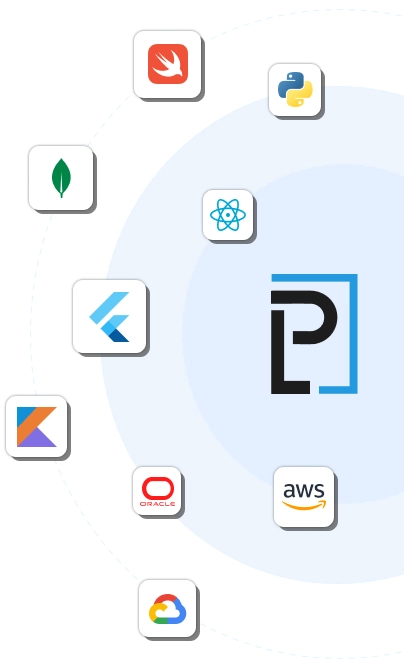
Languages: HTML5, Java, Python, Swift, Kotlin, JavaScript, PHP, CSS3, JS,
Frameworks and libraries: React, Angular, jQuery, Django, Node.js, Bootstrap, Vue JS,
Databases: MySQL, PostgreSQL, Redis
Hosting: AWS, VULTR
Analytics: Amazon EMR, Google Analytics
Web server: nginx, Apache HTTP Server
Utilities: Cloudflare, Microsoft Azure, Amazon S3
At Plurance, the leading custom EHR Software Development company, we have contributed to the design and development of more than five EHRs that are used in hospitals and by patients. Our development team is aware of the healthcare compliance required to create an effective EHR system that conforms to all rules. Furthermore, our extensive knowledge of developing cutting-edge EHR software with the appropriate combination of technologies is what sets us apart as a trustworthy brand in the healthcare software industry.
We provide experience in developing and putting into place effective Electronic Health Records (EHR) systems that provide interoperability, scalability, and high security. We improve patient care, increase data accessibility, and use blockchain for safe data management, making our services future-ready. We have expertise with groundbreaking projects like health-e-people and DiabeticU.
All you need to do is start your EHR software development adventure by contacting our team of healthcare professionals.














Let's talk about your ideas. All information is kept absolutely confidential.
 IND
#7 Kannadasan Main Road,
IND
#7 Kannadasan Main Road, Shams Business Center,